
A heat pump is a device that transfers thermal energy from a low-temperature heat source to a high-temperature heat source; as the ambient temperature decreases, the workload required of the compressor increases.
The energy efficiency of a heat pump is typically expressed by its Coefficient of Performance (COP); a higher COP indicates a greater capacity for pumping low-grade heat. Air-source heat pumps are generally highly susceptible to ambient temperature fluctuations; the lower the ambient temperature, the lower their COP.
When the outdoor temperature drops below -15°C, two issues arise: first, the thermal energy available in the air becomes extremely scarce; second, under such extreme cold, the pressure differential between the interior and exterior of the heat pump increases rapidly. A drop in the evaporator's evaporation temperature can lead to a reduction in the refrigerant flow rate through the system. This impairs the heat exchanger's efficiency in extracting heat, thereby increasing the workload on the compressor. Consequently, it becomes increasingly difficult for the heat pump to absorb sufficient heat from the outdoor air, while simultaneous frost accumulation further hinders heat absorption.
Is there, then, a technology capable of mitigating these issues—one that enables air-source heat pumps to operate stably and efficiently even at temperatures as low as -30°C to -40°C? The answer is a resounding yes: Enhanced Vapor Injection (EVI) technology.
Introduction to Enhanced Vapor Injection (EVI) Systems
The core of jet-enhanced enthalpy technology lies in achieving highly efficient energy conversion through the use of a jet-enhanced enthalpy compressor.
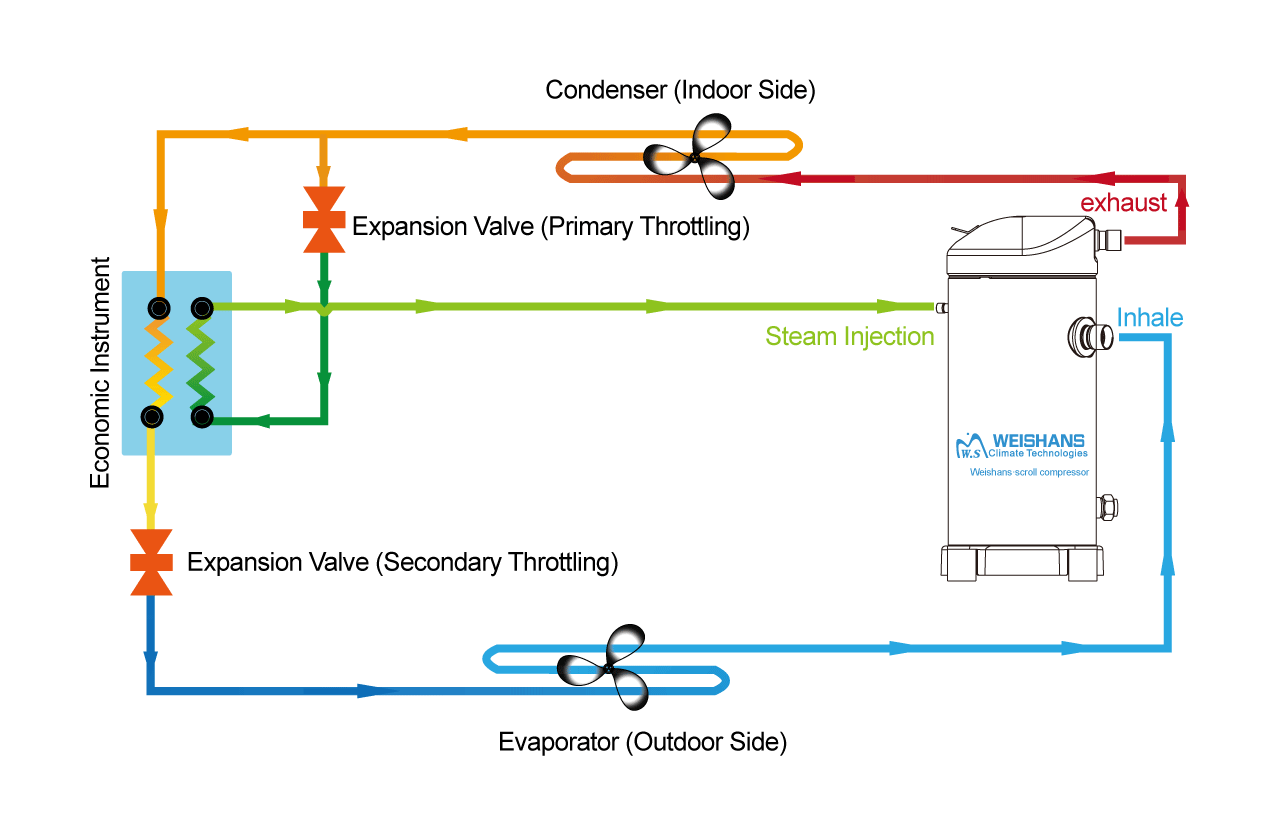
In a jet-enhanced enthalpy system, high-temperature, high-pressure refrigerant gas discharged from the compressor outlet enters the indoor-side condenser, where it undergoes exothermic condensation. The released heat is transferred to an external medium—such as air—which, having absorbed the heat and risen in temperature, is then utilized to provide indoor heating.
Upon exiting the condenser, the refrigerant splits into two paths: the main loop, which constitutes the primary refrigeration cycle (currently operating in heating mode), and the auxiliary loop, which serves as the gas injection circuit.
In the auxiliary loop, the liquid refrigerant passes through an expansion valve, where its pressure is reduced to an intermediate level, resulting in a gas-liquid mixture. This mixture then enters an economizer to undergo heat exchange with the higher-temperature liquid refrigerant flowing through the main loop.
Having absorbed heat, the gas-liquid refrigerant mixture in the auxiliary loop evaporates into a gaseous state. It is then injected into an intermediate port on the compressor to facilitate supplementary compression—a process referred to as "jet injection."
Meanwhile, the liquid refrigerant in the main loop loses heat during the exchange process and is subsequently cooled—effectively undergoing a second stage of subcooling. After passing through an expansion valve for throttling and pressure reduction, it is directed to the outdoor evaporator.
Within the evaporator, the liquid refrigerant absorbs heat from the low-temperature outdoor environment, evaporating into a low-temperature, low-pressure refrigerant gas.
Thanks to the additional subcooling provided by the economizer, the enthalpy difference—the amount of heat absorbed per unit mass—during the refrigerant's evaporation in the evaporator is significantly increased. This enhancement of the refrigerant's heat absorption capacity is what is known as "enthalpy augmentation."
Schematic Diagram of the Jet-Enhanced Enthalpy System
Key Features of Jet-Enhanced Enthalpy Technology
1. Enhanced Heating Capacity
Jet-enhanced enthalpy technology can significantly boost a heat pump's heating performance in extremely cold environments.
Taking the R410A jet-enhanced enthalpy compressor as an example: at an ambient temperature of -15°C, heating capacity can be increased by approximately 30%.
2. Rapid Warm-up
Heat pumps utilizing jet-enhanced enthalpy technology can raise the indoor temperature to the desired setpoint more quickly—typically about 10% faster than traditional systems.
3. Higher Air Outlet Temperature
Under identical airflow conditions, jet-enhanced enthalpy heat pumps deliver a higher air outlet temperature, thereby facilitating rapid indoor heating.
4. Extended Service Life
By lowering the compressor's operating temperature, jet-enhanced enthalpy technology reduces mechanical wear and minimizes the risk of malfunctions, thereby extending the overall service life of both the unit and the compressor.
Weishans Jet-Enhanced Enthalpy Scroll Compressor: An Introduction
1. Defying Extreme Cold, Delivering Stable Heating
Weishans jet-enhanced enthalpy compressor features an ultra-high compression ratio design, enabling the system to operate normally—and provide a continuous, steady supply of indoor heating—even in ultra-low-temperature environments reaching -35°C.
2. Reliable Performance, Energy-Efficient, and Low-Noise
Through an innovative jet injection structure design, Weishans jet-enhanced enthalpy compressor has undergone rigorous, comprehensive reliability testing under various extreme operating conditions. This ensures the compressor operates stably across a wide range of complex environments, providing users with long-term, dependable heating assurance. Furthermore, by integrating advanced noise optimization technologies, the unit delivers a uniquely quiet and tranquil user experience.
3. Technological Innovation: Empowering Heating Performance
The jet-enhanced enthalpy compressor serves as the core component of the entire system. Visually, it distinguishes itself from traditional compressors by featuring a dedicated port for jet-enhanced enthalpy injection. This design allows the compressor to simultaneously compress and inject/mix cooling gas during the medium-to-low pressure stage, before proceeding with the standard compression process during the high-pressure stage. This operational method increases the compressor's discharge volume, thereby significantly boosting its heating capacity in low-temperature environments. Additionally, by integrating its own proprietary technologies, Weishans has optimized the compressor's structural design to expand its operational envelope, making it exceptionally well-suited for heating applications in regions subject to extreme cold.
Adhering to a product philosophy of "striving for precision over cleverness, and substance over superficiality," Weishans specializes in the design, R&D, manufacturing, and sales of scroll compressors. If you are interested in our vapor injection scroll compressors—or would like to learn more about Weishans scroll compressor product line—please feel free to leave us a message or contact our sales representatives at any time!
Copyright © Suzhou Weishans Climate Technologies Co.,Ltd. all rights reseved Su ICP 123456789